

Treasure Coast looks like a typical Psilocybe cubensis: golden to caramel-brown caps, pale stems, a dark purple-brown spore print and blue bruising where the flesh is damaged. Dutch-Smart describes the cultivar as fast to colonise, with relatively slender stems and dense harvests over several flushes in quick succession. Growers add that it varies a lot in size and sometimes throws white fruits. No published key separates it from other cubensis cultivars by eye; the label on the kit is what tells you which culture you have.
The shop's profile
Dutch-Smart has two descriptions of the cultivar, one on the XXL kit and one on the spore ampoule and spray. Put side by side:
| Trait | Dutch-Smart's description |
|---|---|
| Colonisation | "known among growers for fast colonisation"; "colonizes very quickly" |
| Harvest | "dense, prolific harvests"; "a bountiful harvest, but spread out over multiple flushes" |
| Flushes | "consecutive flushes, with very little time between each one"; "the first flush usually giving the biggest harvest" |
| Stems and caps | "relatively slender stems and golden-brown caps" |
| Bruising | caps "that bruise strongly blue when damaged, indicating an above-average psilocybin content" |
| White fruits | "Albino variants sometimes form" |
| Substrates | grows well on brown rice flour, grains, and pasteurised or sterilised substrates such as compost or hay |
Read together, the shop's picture is a vigorous, productive cultivar that keeps fruiting, on slimmer stems than the stockier cultivars. The figures behind words like "fast" and "dense" are the shop's own experience with its cultures; we found no independent trial that measured colonisation speed or yield for this cultivar.
What growers report
Grow logs and strain write-ups online describe a cultivar with a wide spread. DoubleBlind summarised reports that ranged "from massive foot-long specimens to pins only growing a few inches", along with mushrooms that stop growing early (aborts) and white, leucistic fruits in later flushes (DoubleBlind). A strain guide gives typical fruits of two to five inches (5 to 13 cm) with caps up to about an inch (2.5 cm), and occasionally much taller ones (Tripsitter).
Both sources also mention growers who found the second and third flushes larger than the first. The shop's kit text says the first flush is usually the biggest. These accounts come from different setups: hobby growers who inoculate their own substrate, against a ready colonised kit with the shop's manual. For the Dutch-Smart kit, follow the shop's text and manual.
The blue bruise, explained
Blue staining is the field sign most people know. It has a chemical explanation. When the tissue of a P. cubensis mushroom is damaged, two enzymes act in turn: one, PsiP, removes the phosphate group from psilocybin and turns it into psilocin, and a second, PsiL, oxidises psilocin so that the molecules link into chains that are blue (Lenz et al., 2020).
So blue bruising shows that psilocybin and psilocin are present, which is why the shop points to it. How deep the blue gets also depends on how hard the tissue was pressed, on its moisture and on time, so the colour is a sign of presence; a laboratory test gives the amount. More on that on the potency page.
Telling it apart from other cubensis
At the level of a single mushroom, you cannot reliably tell Treasure Coast from Golden Teacher, B+ or Mexican. All are the same species. Cap colour, stem thickness and size vary with substrate, light, humidity and flush, often more than they vary between cultivars. Genetic work points the same way: most commercial cultivars descend from related populations, and cultures sold under one name can differ between suppliers (McTaggart et al., 2023; Kurzbaum et al., 2025).
What does mark a Treasure Coast grow, if it matches the shop's profile:
- a fast, even colonisation of the substrate;
- slimmer stems than the stocky cultivars, with golden-brown caps;
- flushes following each other closely;
- now and then a white or near-white fruit among the brown ones.
None of these is diagnostic on its own. Together they are what growers mean when they say a grow "looks like Treasure Coast".
What you see in the kit, step by step
| Stage | What it looks like |
|---|---|
| colonised block on arrival | white mycelium through the grain substrate |
| pinning, 1 to 2 weeks after setup | the first pinheads appear (the shop's timing) |
| growth, 5 to 7 days | caps open from a closed, egg shape; a pale veil under the cap |
| ready | just before the veil under the cap tears, the shop's harvest point |
Timing is from the shop's usage text for the XXL kit at 20 to 24 °C. The grow kit page has the full product details and the legal position.
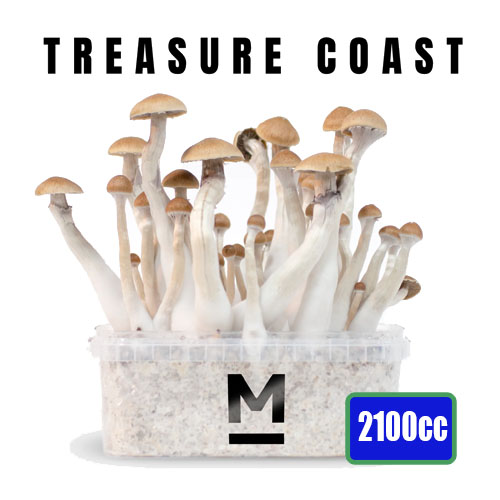 Treasure Coast XXL - 2100cc Mushroom Grow Kit
View at Dutch-Smart
Treasure Coast XXL - 2100cc Mushroom Grow Kit
View at Dutch-Smart
 Treasure Coast - Traces Spray 20ML
View at Dutch-Smart
Treasure Coast - Traces Spray 20ML
View at Dutch-Smart
Next: how strong it is, and what is unknown and the Florida story behind the name.