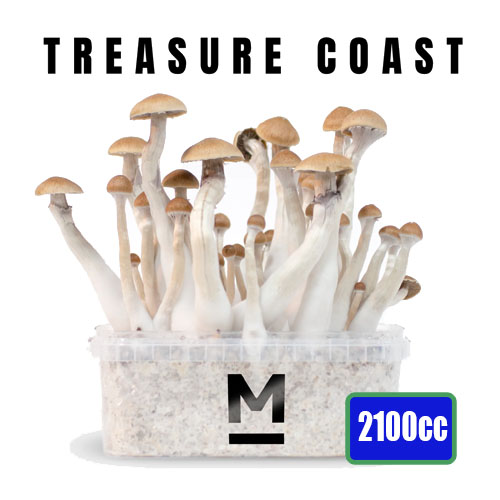
Psilocybe cubensis grows wild in Florida on the dung of cattle and horses and in manured pasture soil. Florida has more public occurrence records of the species than any other US state: 551 in the Global Biodiversity Information Facility on 16 October 2026, against 185 for Texas and 93 for Louisiana (GBIF data). One of the herbarium specimens comes from a pasture at Fort Pierce, the heart of the Treasure Coast.
A species described twice, once from Florida
The species was first described in 1906 by the American mycologist Franklin Sumner Earle, from Cuba, as Stropharia cubensis. In 1941 William Alphonso Murrill, then working at the University of Florida in Gainesville, described what he took to be a new species, Stropharia cyanescens, in a paper titled "Some Florida Novelties" (Mycologia 33: 279 to 287). Rolf Singer moved the species to Psilocybe in 1949, and Murrill's Florida name is now regarded as a synonym (Wikipedia).
Murrill's collections are still in herbaria. The labels from 1938 and 1939 read "sawdust pile in stable", "cow dung in oak-pine woods" and "dung under oak", all from around Gainesville (GBIF records). So the mushroom was growing in north Florida decades before anyone sold spores of it.
The Treasure Coast specimens
Among the 47 preserved Florida specimens in GBIF, three come from the Atlantic side or the cattle country inland of it:
| Date | Place | Label | Herbarium |
|---|---|---|---|
| 23 July 1971 | Fort Pierce, St. Lucie County | "on cow dung in pastures" | University of Florida, FLAS-F-49126 |
| 10 January 1972 | Interstate 95, Brevard County | collected by the Bureau of Narcotics and Dangerous Drugs | US National Fungus Collections |
| 28 January 1973 | Clewiston, Hendry County | "on manure piles in pastures", collected by the health department | University of Florida |
The collectors say something about the period. The Fort Pierce label names the FBI as collector, the Brevard one a federal narcotics bureau, the Clewiston one a health department. In the early 1970s wild cubensis from Florida's pastures was a matter for police and public health, and specimens ended up in university herbaria as reference material. None of these records is the origin of the Treasure Coast cultivar; they show that a cultivar collected in the region would have had plenty of wild stock to come from.
Where it grows
P. cubensis is coprophilous: it grows on dung, usually of cattle and occasionally horses, on sugar cane mulch and on rich pasture soil. That description goes back to the work of Singer and Smith in 1958. In the United States it is recorded mainly in the Gulf Coast states and the southeast. The species needs grazing animals, and Florida's cattle pastures, from the ranches inland of the Treasure Coast to the prairies around Gainesville, provide exactly that habitat.
The species is not native everywhere it grows now. A genome study of an Australian population concluded that it was introduced there and later naturalised, probably with cattle (McTaggart et al., 2023). Where the Florida populations came from has not been studied in the same way.
When it fruits
Florida's GBIF records, observations and specimens together, show a clear season. June and July have the most records, 104 and 103; February and March the fewest, 21 and 20. That matches the general picture of the species fruiting through the warm, wet months, and from February to December in the northern hemisphere. Records follow observers as well as mushrooms, so read the months as a rough pattern.
| Month | Florida records |
|---|---|
| June | 104 |
| July | 103 |
| August | 59 |
| September | 52 |
| April | 38 |
| October | 37 |
| January | 33 |
| December | 29 |
| November | 26 |
| May | 25 |
| February | 21 |
| March | 20 |
Why this site does not help you pick
Florida pastures carry many small brown mushrooms, and several grow on the same dung. Some Panaeolus species and other small dung fungi share the habitat, and poisonous species turn up in lawns and pastures across the state. Identifying mushrooms in the field takes training, a spore print and often a microscope, and a wrong guess can mean poisoning. This site does not give identification keys for foraging.
There is a legal side as well. Psilocybin and psilocyn are Schedule I substances in Florida, and a 1978 court case about wild mushrooms is often misread as permission to pick them. It is not; the law page explains what the case decided.
For telling the cultivar apart in cultivation, see recognising Treasure Coast. For the story behind the name, see name and origin.